Product Description
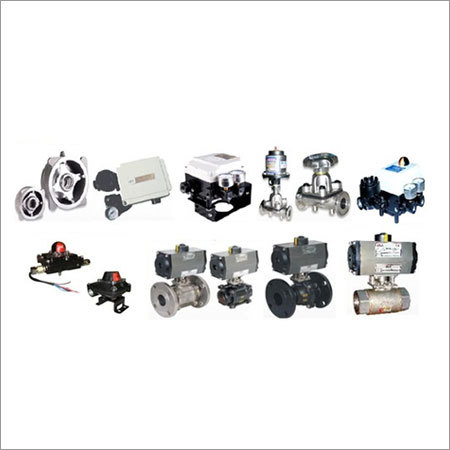
The Ball valves with actuators that we offer are available at the nominal rate. The offered actuators have compact designs and are acknowledged in the market for their outstanding performance. These are designed from the finest grade stainless steel and carbon steel that is procured from esteemed vendors. These actuators fins their extensive use in chemical, oil and gas, refinery, energy, pharmaceutical, food & beverage and cosmetics. In addition, these Ball valves with actuators are suitable for powder & granular fluid as well.
Features:
- Low operation time
- Highly adjustable
- Can withstand high temperature
Optimal Flexibility for Industrial DemandsThese ball valves with actuators are engineered to meet diverse industry needs, offering multiple body designs, mounting options, and material choices. Whether you require one, two, or three-piece construction, and prefer stainless steel, carbon steel, or brass, the selection ensures compatibility with numerous applications. Their direct ISO 5211 mounting and a broad caliber range (DN15DN300) make installation straightforward and adaptable.
Advanced Automation and ControlOperational efficiency is enhanced with automatic or remote control modes. Electric actuators can be powered by a wide voltage range 24V, 110V, or 220V (AC/DC) and support precise control signals (4-20mA, 0-10V, or 3-position). For pneumatic options, a reliable air supply of 47 bar ensures robust double-acting performance, while enclosure protection ratings of IP65 and IP67 safeguard your process in challenging environments.
Rugged Construction and Superior SealingFeaturing PTFE, EPDM, or NBR seals and a blow-out proof stem, these valves provide bubble-tight (Class VI) leakage prevention for media temperatures ranging from -10C to 180C. Structural options, from two-piece to three-piece designs, plus polished or painted finishes, further enhance durability, longevity, and resistance to harsh chemicals. The choice of single or double channels and ANSI/DIN/JIS flanges ensures compatibility with global standards.
FAQs of Ball valves with actuators:
Q: How do ball valves with electric and pneumatic actuators operate in an automated system?
A: These valves utilize electric (spring return) or pneumatic (double acting) actuators to open or close flow remotely or automatically. Electric models receive control signals (such as 4-20mA or 0-10V) to modulate or switch positions, while pneumatic versions use pressurized air (47 bar) for precision actuation, supporting integration into industrial automation systems.
Q: What are the advantages of PTFE, EPDM, and NBR seal materials in these valves?
A: PTFE offers excellent chemical resistance and low friction, making it ideal for aggressive media. EPDM is suited for water and steam applications due to its resilience, while NBR provides good oil and fuel compatibility. Choosing the right seal ensures long-term reliability and minimizes maintenance in specific media and temperature conditions.
Q: When should I choose a one-piece, two-piece, or three-piece body design?
A: Select a one-piece body for cost efficiency and basic applications; two-piece for easier maintenance and improved leakage protection; and three-piece for demanding environments that require frequent servicing, cleaning, or valve removal without disturbing the pipework.
Q: Where can these ball valves with actuators be installed?
A: These valves are designed for use in industrial automation, water treatment, HVAC systems, and chemical processing industries. Their versatile mounting options (ISO 5211 direct mount) and compatibility with flanged, threaded, or socket weld connections make them suitable for new installations or retrofits in facilities across India.
Q: What is the process for selecting the best actuator type and control signal?
A: Begin by assessing your sites energy availability (electricity or compressed air), operational preferences (automatic or remote control), and required response speed. Electric actuators are optimal for precise control and remote operation, while pneumatic versions provide faster cycle times. Align the actuator control signal (4-20mA, 0-10V, or 3-position) with your automation system for seamless integration.
Q: How does the IP65/IP67 enclosure rating benefit valve installations?
A: IP65 and IP67 ratings ensure that the actuator and electrical components are protected from dust ingress and water exposure, safeguarding reliability in harsh, wet, or dusty environments typically found in industrial and process applications.
Q: What are the key benefits of using blow-out proof stems and Class VI leakage valves?
A: Blow-out proof stems enhance operational safety by preventing stem ejection under pressure, while Class VI (bubble-tight) leakage specification guarantees superior sealing performance, preventing wastage and contaminationcrucial in chemical, water, and gas handling operations.





 Send Inquiry


 Send Inquiry
 Send SMS
